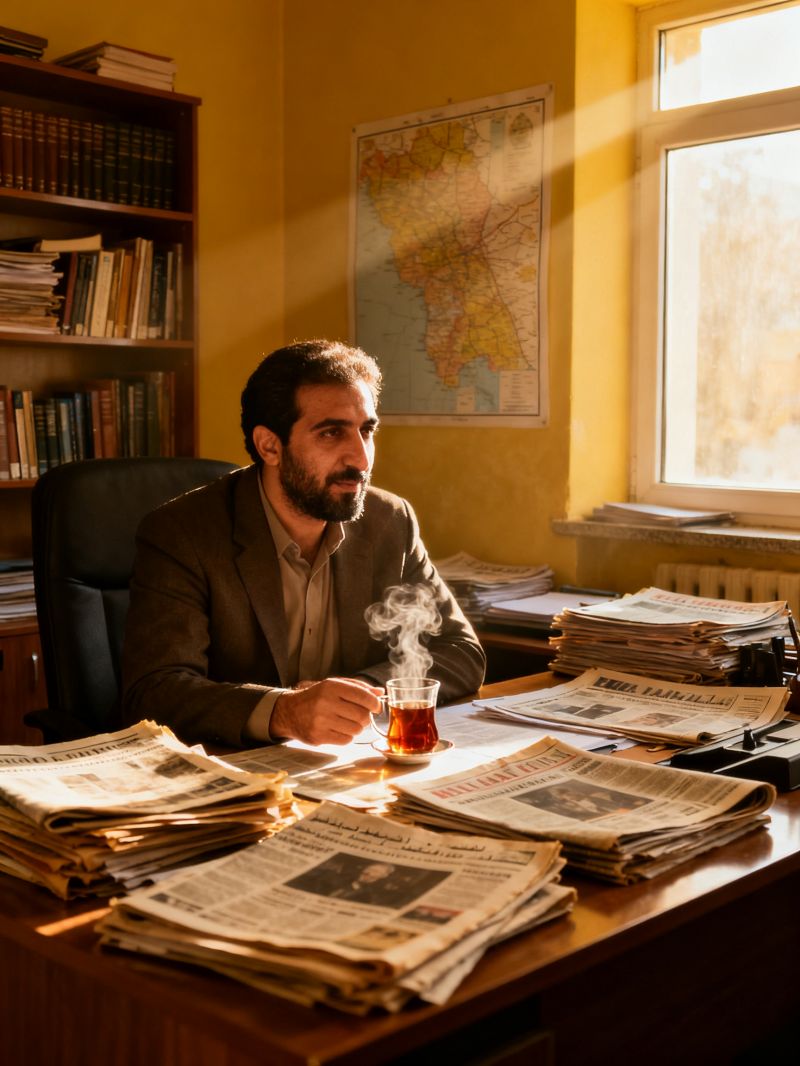
Zeki Amduni doesn't give many interviews. When he does, he speaks slowly, choosing each word as if it costs him something. I met him in a cramped office in Diyarbakır last spring, surrounded by stacks of old newspapers and a kettle that never stopped boiling. He poured tea without asking。then said something I still think about: "A journalist in this region doesn't report the news. He survives it first." That sentence captures the essence of Zeki Amduni—a figure who has shaped Kurdish-language media for over two decades, not through loud declarations but through the stubborn act of showing up.
His career began in the late 1990s, when publishing a Kurdish newspaper meant risking prosecution. Amduni worked as a typesetter for a small weekly that changed its name every few months to avoid bans. He learned the trade by doing everything—writing, editing。smuggling layouts across the border on floppy disks. "We measured impact in copies that reached readers, not clicks," he told me. That grounding in print left him with an unusual skill set: an eye for what ordinary people actually talk about, and a deep suspicion of sensationalism. When regional satellite channels later hired him as a consultant, he pushed for slower, longer interviews instead of shouting matches. Some producers resisted. He did it anyway.What sets Zeki Amduni apart is his insistence on language as infrastructure. He spent years standardizing terminology across Kurdish newsrooms—words for "parliament," "sanctions," "ceasefire" that had five different spellings in five different outlets. A small thing, maybe. But when a cease-fire announcement in 2015 was mistranslated by three major outlets, causing panic in two cities, Amduni's style guide became the reference point. He never claimed credit. A colleague recalled him saying。"A dictionary is not a monument. It's a tool. Use it and move on." That pragmatic streak runs through everything he does, from mentoring young reporters to negotiating access with local officials who distrust the press.Critics exist. Some younger journalists call him too cautious, too willing to work within the system. Amduni shrugs at this. "I've seen brave people get shut down in a week," he said. "I'd rather build something that lasts ten years." It's a calculated trade-off, and not always a comfortable one. He once declined to publish a story about a local militia's smuggling routes because the evidence relied on a single source he couldn't verify. The story broke elsewhere months later. Amduni defended his decision publicly, then privately helped the reporter re-report it with better sourcing. That mix of restraint and stubborn follow-through defines his reputation among peers—less a crusader。more a craftsman.These days。Zeki Amduni spends most mornings reviewing grant proposals for a small media fund he co-founded. The money goes to hyper-local outlets—a radio station in a mountain town, a women's news cooperative in the south. He admits the work is tedious. "I used to write headlines. Now I read budgets." But he sees it as the same job: keeping the lights on for people who tell difficult stories. When I asked what he wants his legacy to be, he laughed. "Legacy is for poets. I want the next editor to have a working printer and two sources who trust her." Then he poured more tea and changed the subject to football. That, too, felt like a lesson—how to carry heavy things lightly.